
Post by Mohamad Nour Abo Amou
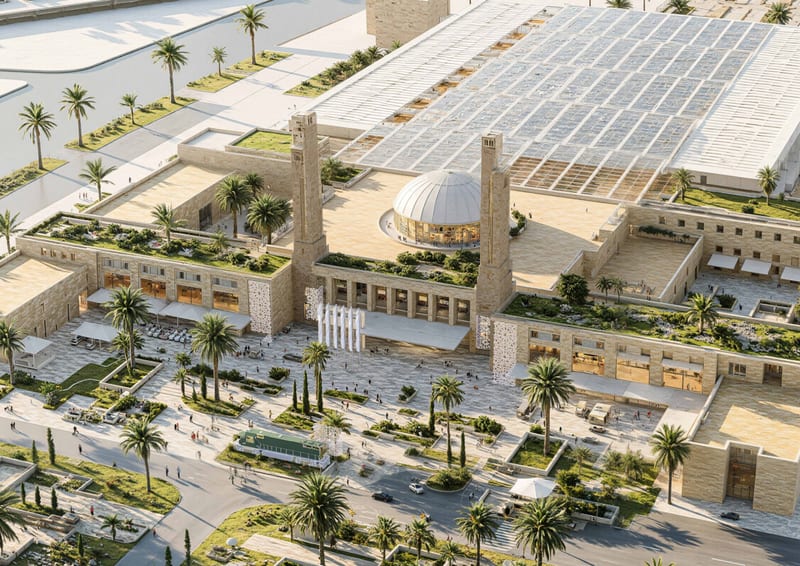
Baghdad Central Railway Station – Adaptive Reuse reimagines one of Baghdad’s most significant modernist landmarks as a new civic and climatic infrastructure for the city. The project’s main goal is to transform the historic station into a dynamic public platform that responds to contemporary urban needs while preserving its architectural identity. Its importance lies in bridging heritage with innovation, turning a once purely transportation hub into a multifunctional urban catalyst. Located in the dense and climatically challenging context of Baghdad, the project addresses both cultural continuity and environmental performance, positioning itself as a resilient intervention within the city.

The design is driven by the concept of adaptive reuse as an urban strategy, where the existing structure becomes the foundation for a new layered system. At its core, the project acts as a connective platform, integrating mobility, culture, and landscape. It introduces a hierarchy of spaces organized around public, semi-public, and infrastructural zones. The ground and upper levels accommodate cultural programs such as exhibition spaces, amphitheatres, and shaded courtyards, encouraging social interaction. Beneath, new underground circulation links train and metro systems, reinforcing connectivity. Environmental strategies—such as PV canopies, green roofs, and climatic clock towers—form an integrated passive cooling network, transforming the station into a “living urban machine.”

The spatial experience is defined by layered movement across and through the site, where users navigate seamlessly between transportation, cultural, and public realms. Horizontal circulation unfolds عبر open platforms and shaded pathways, while vertical connections lead to underground transit networks and elevated public spaces. Transitional zones, such as courtyards and semi-covered gathering areas, create moments of pause and climatic relief within the harsh environment. These spaces enhance both comfort and social interaction. Ultimately, the project reflects its vision by merging heritage with contemporary function, demonstrating how adaptive reuse can become a powerful architectural tool for urban regeneration, environmental performance, and collective experience.